

Are Vintage Posters a Good Investment? An Honest Look at the Market
Collectors often ask us whether a vintage poster "holds its value". It is a fair question, and the honest answer is more nuanced than most dealers will tell you. Here is what we know, what the auction results show, and where the risks lie.
A word first: we are a gallery, not financial advisers. Nothing below is investment advice. We buy posters because we love them, and we think you should too. But a poster can also be a store of value, and it is worth understanding how.
Why posters can hold value
Three things work in their favour.
- They were never meant to survive. A poster was a piece of street advertising, pasted on a wall and torn down or covered over within weeks. The few that reached us were kept by chance. Supply of any given image is small and cannot grow.
- The technique is gone. Many posters made between 1880 and 1950 are stone lithographs, a process that is no longer cost-effective. Nobody can make a new original.
- The big names are established. Toulouse-Lautrec, Mucha, Cappiello or Cassandre are catalogued, studied and collected worldwide. Their market is deep, with specialist auction houses holding dedicated poster sales for decades.
Collectors also point to practical advantages. A poster is a tangible object you can enjoy every day, and it is easy to display, store and transport compared with a sculpture or a piece of furniture. The entry point is low next to most forms of art. The market is international, so a piece can be bought and sold almost anywhere. And you keep personal control: nobody manages it for you, which is a pleasure and a responsibility. Posters also make personal gifts for a friend or a client: because their subjects are so varied, you can match one to a hobby, a period, a favourite destination or a person's own line of work, and it speaks more directly than a painting usually does. Nostalgia for the golden age of travel and advertising, and the tastes of a generation now at its peak buying power, have also supported demand. None of this guarantees a rise in prices, but it explains why the market exists.
What the auction results show
At the top of the market, prices can be high. At Poster Auctions International's sale of 14 November 2021, a Toulouse-Lautrec Jane Avril (1899) made $108,000, and a 1923 Fiat racing poster by Plinio Codognato $90,000. In March 2023, the same house sold Mucha's The Stars (1902) for $114,000. These figures include the buyer's premium and come from the auction house's own press releases, so they should be read as a guide rather than an audited index.
The French market tells a similar story. According to Boursorama, a poster of La Goulue by Toulouse-Lautrec reached €166,000 in 2022, and a chromolithograph by Jan Toorop was sold for €65,000 by Ader in Paris in April 2025. In the United States, the film poster collection of Dwight Cleveland made $1.45 million at Heritage Auctions in March 2025, which shows how much appetite there is for well-documented collections.
But look at the other end. At UK auctions in 2020, a 1920s Salmson car poster sold for £2,500, a Guinness poster by John Gilroy for £350. The same market holds both.
| Poster | Sale | Price |
|---|---|---|
| Mucha, The Stars (1902) | PAI, March 2023 | $114,000 |
| Toulouse-Lautrec, Jane Avril (1899) | PAI, November 2021 | $108,000 |
| Cappiello, Kub (1931) | PAI, November 2021 | $60,000 |
| René Vincent, Salmson 10 HP (1920s) | Tennants, September 2020 | £2,500 |
| John Gilroy, Guinness "Tortoise" | Woolley & Wallis, March 2020 | £350 |
A sample of public auction results. Prices include buyer's premium. Sources: Poster Auctions International; The Saleroom.
For a first purchase, French financial press puts the typical entry ticket at a few hundred to a couple of thousand euros, which keeps the market accessible compared with paintings or sculpture.
Ski posters show how much condition matters. Sophie Churcher, then poster specialist at Christie's, once explained that a Francisco Tamagno poster of 1900, estimated at £5,000 to £7,000 in one sale, had been sold by the house for £17,500 in 2009 in a better state. The reason, she said, is also one of rarity: many ski posters were torn down and thrown away at the end of the season, so few survived, and those that did often kept vivid colours thanks to the quality of the lithography. These are old figures and should be read as an illustration of the principle, not as today's prices.
Christie's ski sale of January 2012 shows the range within a single auction. A Roger Broders poster of Saint-Pierre de Chartreuse, estimated at £5,000 to £7,000, sold for £32,450, and two Emil Cardinaux views of St Moritz made £25,000 and £23,750. Yet a Walter Herdeg poster of a skier adjusting her bindings sold for £813 in the same sale. The auction achieved a 96% sell-through rate, but the spread between the top and the bottom of the catalogue is the real lesson.
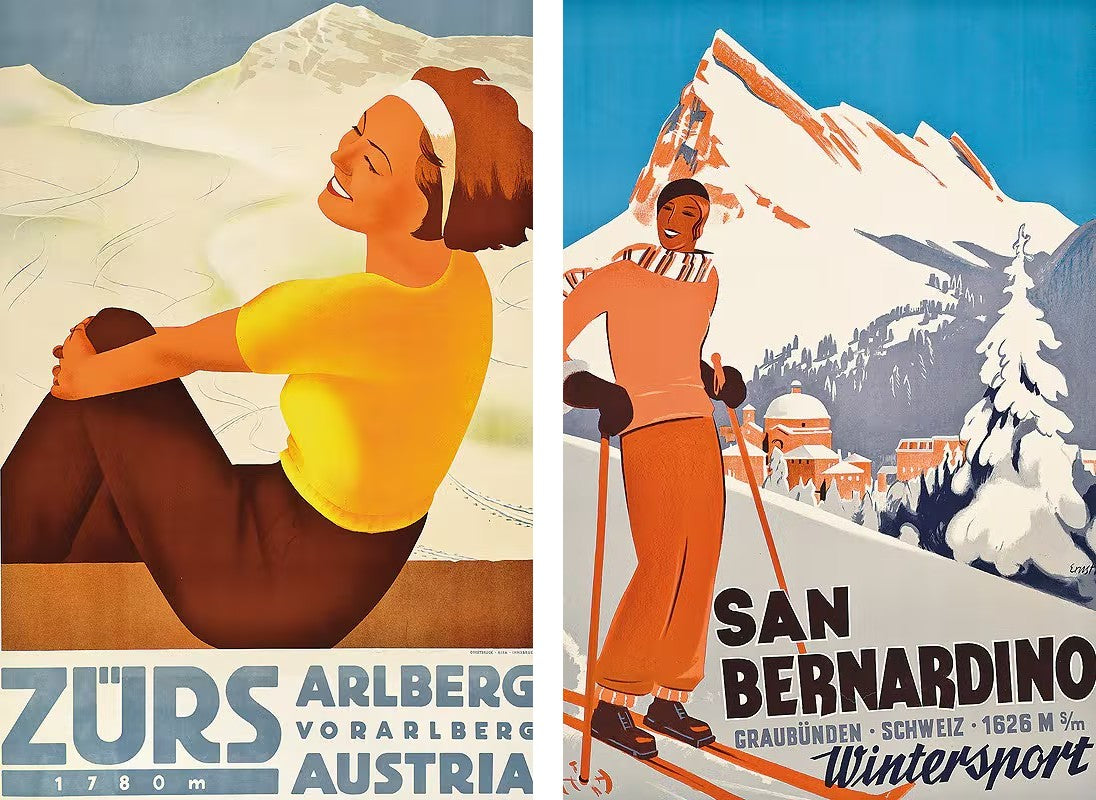
Two Alpine ski posters: Zürs, Arlberg (Austria) and San Bernardino (Switzerland).
Is there a trend over time? A chart published by Christie's of the average poster price at its ski sales between 2005 and 2016 gives a useful picture, with the usual warning that comparable data is hard to obtain in this market and that the average depends on which lots happen to be in each sale.
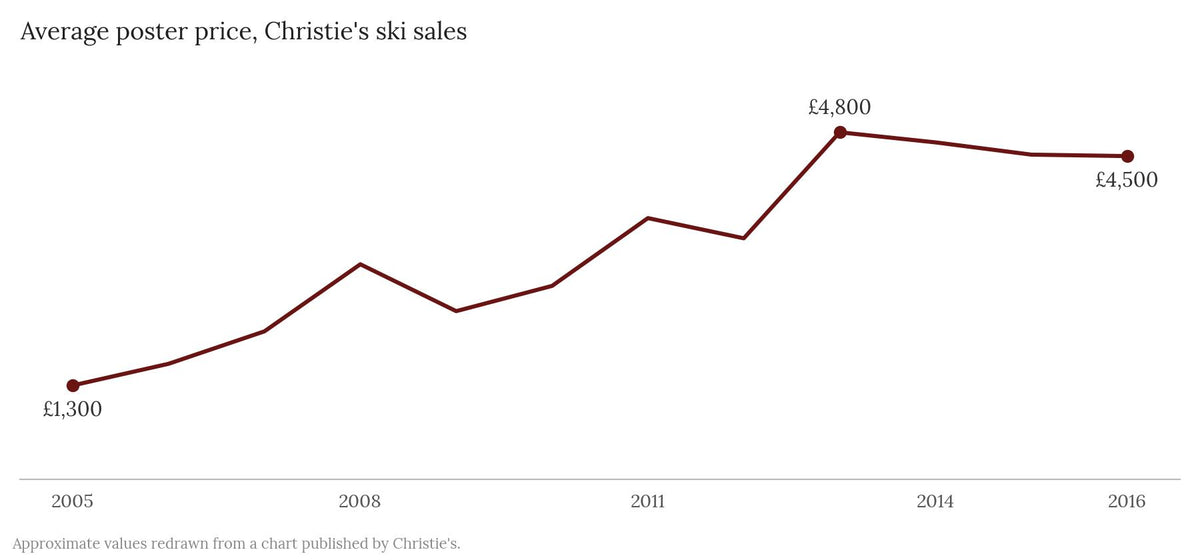
Average poster price at Christie's ski sales, 2005–2016 (approximate values, redrawn from a chart published by Christie's).
Read plainly, the average rose from roughly £1,300 to roughly £4,500 over eleven years. That is about 12% a year if you compound it, in pounds and before fees, insurance or inflation. The path was far from smooth: the average fell in 2009 and 2012, peaked around 2013, and has been flat to slightly lower since. It is encouraging for the ski segment, but it is one market, over one period, and past results do not promise future ones.
The lesson: "vintage poster" is not one asset. A famous image in fine condition and a decorative piece by a lesser-known hand behave very differently.
What drives the value of a single poster
- Originality. A first printing is worth far more than a later reprint, and a reproduction is worth only its decorative value. This is the foundation of everything else. Our guide to telling an original from a reproduction explains how to check.
- The artist. Recognised designers command a premium, and a documented name is easier to resell than an anonymous work.
- Subject and period. Travel, skiing, motor racing, aviation and glamorous destinations are consistently sought after. Art Nouveau and Art Deco have strong followings.
- Rarity. Small print runs and few surviving copies push prices up. For a given image, ask how many have been sold publicly.
- Condition. Auction houses commonly grade posters from A (excellent) to D (needs restoration). Tears, losses, stains, fading, trimmed margins and tape all weigh on price, and restoration usually brings a discount compared with a piece that never needed it. Professional linen-backing is standard practice for larger pieces, but it is no substitute for a good original state.
- Fashion changes. Rarity is mostly a question of what survived, and tastes move. Jules Chéret, the father of the modern poster, has lost some of his market standing in recent years, while Art Nouveau names such as Mucha remain strongly sought after. Post-war work, including Savignac, Villemot or Gruau, now sits alongside the early masters for many collectors.
The risks, plainly
- Prices do not always rise. You will see claims such as "values doubled in five years". Be cautious: such statements are rarely backed by dated figures or a source. There is no recognised index for the poster market in the way there is for shares.
- It is illiquid. You cannot sell a poster in a day. A good sale means waiting for the right auction or the right buyer.
- Costs are real. Buyer's premiums at auction, seller's commissions, shipping, insurance, framing and conservation all reduce what you finally gain. Conservation framing of a large poster alone often costs several hundred euros.
- Fakes and reprints. Because some images are heavily reproduced, buying without verification is the most expensive mistake a new collector can make.
- Taxes differ by country. Rules on capital gains and on works of art vary widely. Ask an adviser in your own country before buying with resale in mind.
How we would approach it
If you want your purchase to keep its value, a few habits help.
- Buy the best condition you can afford. One fine piece usually serves better than three damaged ones.
- Buy what you want to look at. A poster you love will be kept and looked after, which is what protects its value.
- Choose a theme. A collection built around one artist, one period or one subject (ski, aviation, a city) is easier to understand, to document and to sell than a random assortment.
- Insist on documentation. Printer, date, artist and size should be stated clearly. Keep invoices and any provenance.
- Protect it. Frame with acid-free materials and UV-filtering glazing, away from direct sun and damp.
- Think in years, not months. This is a long-term holding, not a trade.
Our descriptions follow these principles: each piece is listed with its artist, printer, date and size, and condition and any restoration are stated openly. You can see the current selection in the gallery, or write to us if you are looking for a particular artist or subject.
Sources: Poster Auctions International press releases (Rare Posters Auctions LXXXV and LXXXIX); The Saleroom, vintage poster buying guide; The Art Syndicate, "Collecting vintage posters"; Boursorama, "Placement plaisir : comment investir dans les affiches de collection" (11 October 2025); Christie's, poster price trends at its ski sales (2005–2016); Classic Driver, report on Christie's Ski Sale (27 January 2012); Christie's specialist quoted in a press feature on vintage ski posters (c. 2010).