

How to Tell an Original Vintage Poster from a Reproduction
The word "vintage" covers a lot of ground. Two posters that look identical on a wall can be worth very different amounts. Here is what we look at before we buy a piece, and what you can check yourself.
First, what "original" means
An original poster is one printed at the time, for the purpose it was made for: to be displayed to advertise a product, an event or a destination. A reproduction is a later printing of the same image. That is not a fault in itself. Some reprints are handsome, documented and honestly sold. The problem only begins when one is presented as the other.
1. Look at the printing
Under a magnifying glass (a 10× loupe is cheap and enough), the printing technique tells you a lot.
- Stone lithography, the classic technique of older posters, gives a grainy, irregular texture. Colours look built up in layers rather than made of dots.
- Offset printing produces a regular pattern of tiny dots. Careful: offset was also used for many genuine posters from the mid-20th century onward, so dots alone do not prove a reproduction. They simply tell you which period to expect.
- Modern digital prints show a very even, mechanical dot pattern, and often a paper that feels too clean and too white for its supposed age.
2. Check the imprint
Posters were usually printed with the name of the printer and often the artist's signature in the image or margin. Read them. Does the printer exist, and did it operate at the date claimed? A poster claiming 1924 with an imprint from a printer that closed in 1910 has a problem.
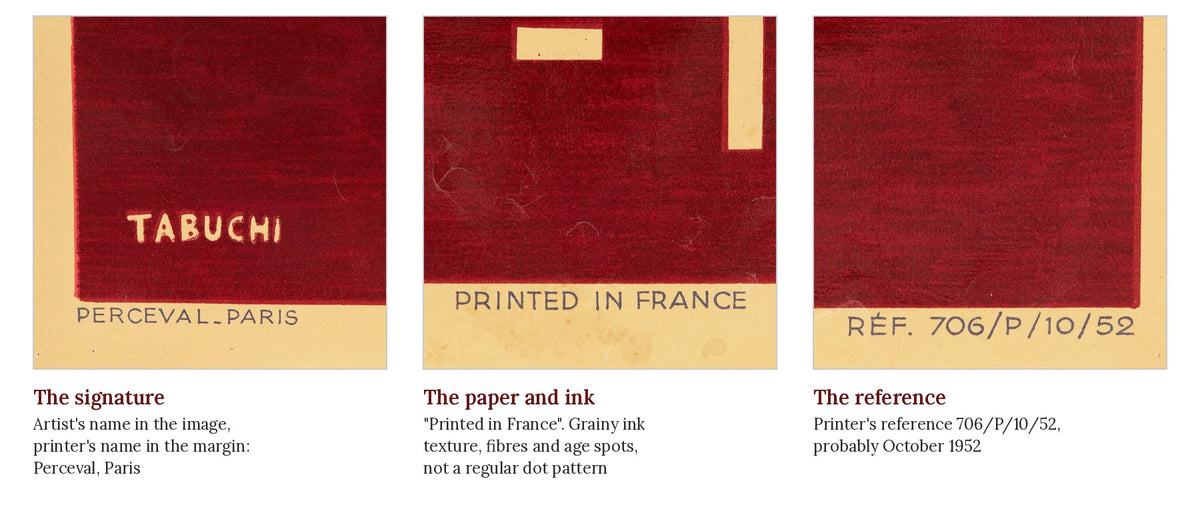
Close-ups of an original Air France poster of 1952 (Tabuchi): the signature and printer's name, the grain of the ink and the paper, and the printer's reference number.
3. Consider size and paper
The format
Modern reproductions are very often printed in standard DIN/ISO paper sizes, typically A0 (84.1 × 118.9 cm) or A1 (59.4 × 84.1 cm), because that is what large-format printers and frame makers use. Early originals predate those sizes: the DIN system was only introduced in Germany in 1922 and spread gradually afterwards. Posters were printed in the traditional formats of their printers and countries, which is why genuine ones have less tidy dimensions, such as our Allenbach at 75.5 × 105 cm.
So a poster dated 1900 or 1925 that measures exactly A0 or A1 deserves questions. It is a clue, not a proof: some later originals do come close to standard sizes, and a reproduction can be cut to any size. Measure it, and compare with documented copies.
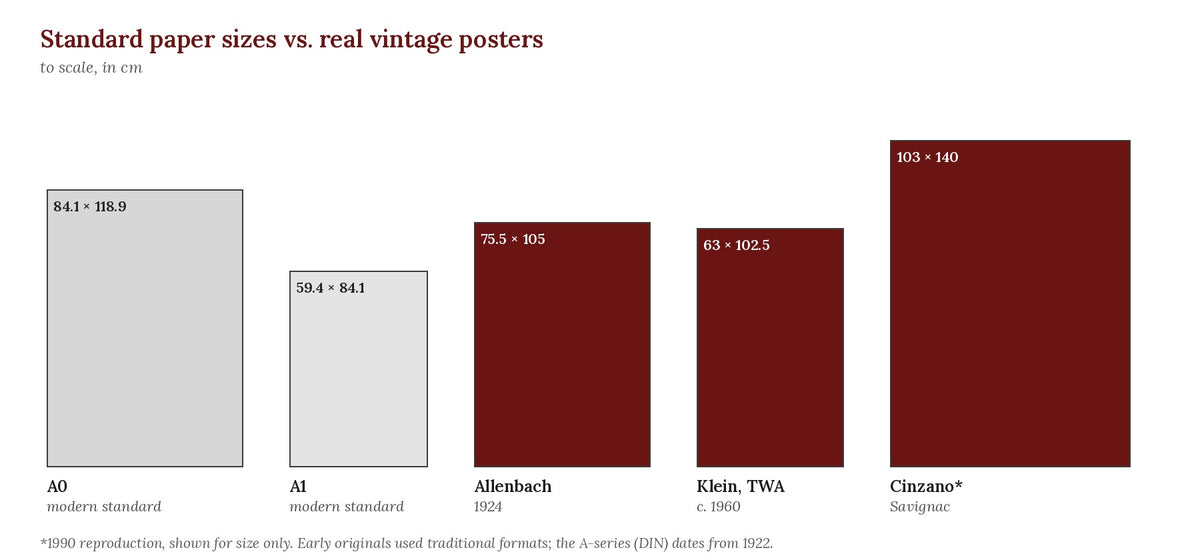
The paper
Many modern reproductions are printed on coated, glossy paper, the kind used for magazines and photo prints. It gives bright, smooth, very even colours that look "modern" on a poster from another era. Original posters were generally printed on uncoated paper, often thin and slightly rough, whose surface looks matt and absorbs the ink. Run a finger lightly across the margin and look at the sheet under a raking light: a plastic-like gloss is a warning sign.
Genuine age shows in a slightly toned, sometimes brittle paper, with wear that follows a logic (edges, corners, folds) rather than looking applied.
4. Look for folds
Most posters were folded for transport and posting, and folds are a good sign of a working life. They are also one of the main reasons collectors have posters restored, which brings us to linen-backing.
5. Check the paper trail
A serious seller can tell you where a poster comes from and can point to references: a museum collection, a catalogue, past auction records. Ask. If the answers are vague, take that as information.
Original, reproduction or later reprint?
There are really three cases. An original was printed at the time, for the campaign, event or destination it advertises. A reproduction is made later to recreate the look of the poster, usually for decoration. In between sits the reprint (or restrike): a later printing, sometimes by the original printer or publisher, which can look very close to the first edition.
Reprints deserve a fair hearing. Successful advertising posters were often printed again for new campaigns, sometimes over many years, commissioned by the advertiser or the artist, using the original plates and methods or with small changes such as a new logo. These period reprints can be collectible in their own right, although they are valued differently from a first edition. What matters is that they are described honestly.
That is why no single clue settles the question. Paper, printing technique, size, printer, edition history and provenance have to be weighed together, ideally against a reliable reference.
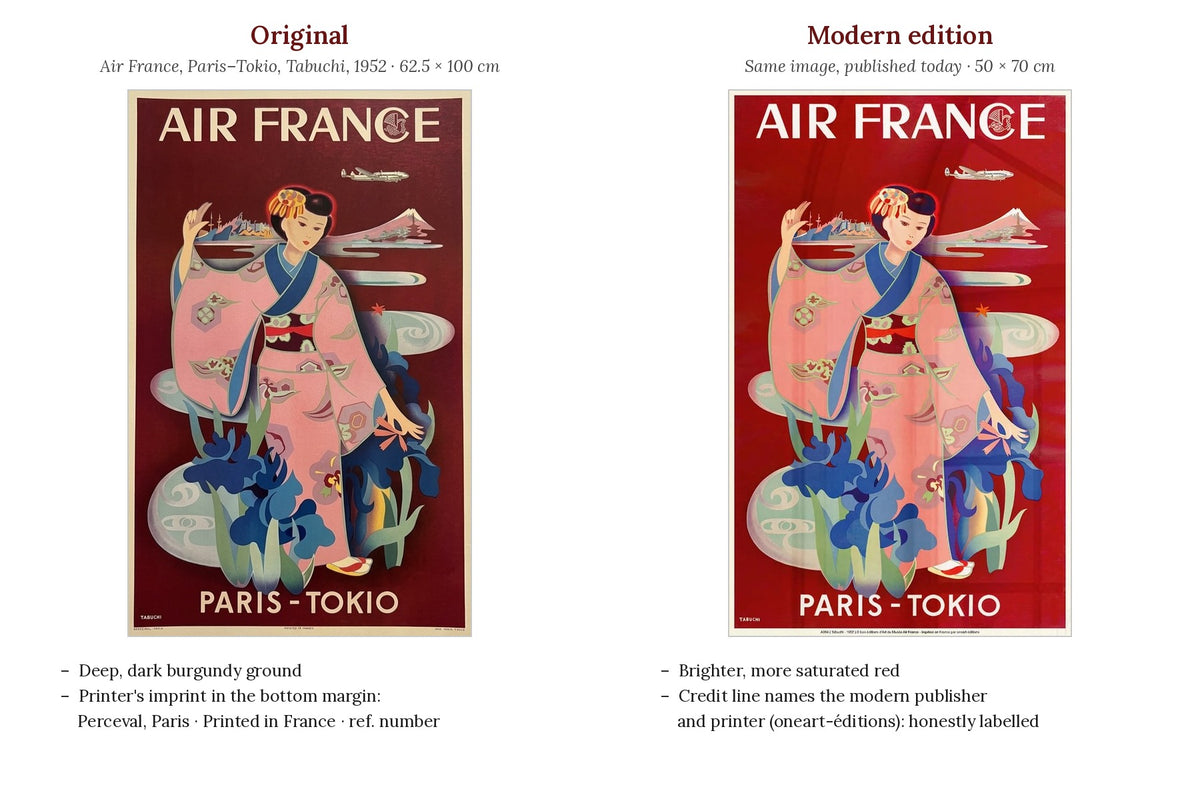
Same image, two objects: an original Air France poster of 1952 (62.5 × 100 cm) and a modern edition (50 × 70 cm). Size, colour and imprint all differ.
Why some artists are reproduced so much
Copyright plays a part. In France and across the European Union, an artist's work stays protected for 70 years after their death, counted from the end of that year. After that it falls into the public domain, and anyone may reprint it without asking or paying.
That is exactly what happened to the great names of the poster's first golden age: Jules Chéret (died 1932), Théophile-Alexandre Steinlen (1923), Henri de Toulouse-Lautrec (1901), Alphonse Mucha (1939), Eugène Grasset (1917) and Leonetto Cappiello (1942). Their images can be printed freely, and they are, in every size and quality, on posters, canvases, mugs and cushions. For these artists, reproductions vastly outnumber originals, so extra care is needed.
Artists who died more recently are still protected. Cassandre (1968), René Allenbach (1958), Raymond Savignac (2002) and David Klein (2005) are examples. A reproduction of their work is either licensed or made without permission, which is one more reason to check who is selling it and how it is described.
Public domain affects the image, not the object. A genuine period print of a Chéret is just as much an original as it ever was. But it means the market for his images is flooded with copies, and it is why the checks below matter so much.
What is linen-backing?
Linen-backing is the standard conservation treatment for a poster on fragile paper. A conservator mounts the poster on acid-free paper and a linen canvas, using reversible materials, so that the sheet is supported, flat and stable. Tears are stabilised and folds are relaxed. Done well, the treatment respects the original and can be undone.
The trade-off is worth understanding. A linen-backed poster is more robust to handle, frame and ship. An unbacked poster keeps its untouched state, but is more delicate. Neither is better in absolute terms, and the condition should always be stated clearly.
Condition and value
Age alone does not set the price. The artist, the subject, rarity, period, graphic quality, historical importance and collector demand all count, and so does condition. Look for tears, missing paper, fold lines, foxing (brown spots), fading, pin holes and old repairs.
Missing paper is the defect to watch most closely. Fold lines, light foxing or soft edge wear are part of a working poster's life, but a loss, a place where paper is simply gone, cannot be undone. It matters most when it falls inside the image or the lettering. Restoration can fill a loss, but the original material is not coming back, so always ask where the losses are, how large they are, and whether they have been restored.
Adhesive tape is the other great enemy. Old posters were often pinned up or taped. Tape dries out, turns brown and leaves a stain that sinks into the paper, and its adhesive is hard to remove completely. Removing it is a job for a conservator. Never repair a tear with tape, and look closely at the edges and corners of any poster you are considering.
Condition has to be read alongside rarity. A scarce poster can stay very desirable with a few flaws, while a common one needs to be in excellent shape to stand out. Whatever the case, the seller should tell you about any restoration, backing, tape residue or missing paper.
Looking after your poster
Paper is sensitive, and the main enemies are light, humidity and poor materials.
- Light. Keep it out of direct sun. Fading is cumulative and cannot be undone. UV-filtering glass or acrylic helps, but it does not make a poster immune to visible light.
- Humidity and heat. Avoid cellars, attics, radiators and cold, damp outside walls. Stable and fairly dry is the goal.
- Framing. For a poster that matters, use acid-free mounts and backing, and keep a mat or spacer between the paper and the glass so they never touch. A framer used to works on paper is worth the extra cost.
- Handling. Clean, dry hands; two people for large sheets; avoid folding it again.
- Never use tape. No sticky tape, masking tape or glue, even on a small tear. It stains the paper and is the hardest damage to reverse. If a poster is torn, leave it as it is and take it to a paper conservator. Rubber bands are best avoided too.
It also helps to keep a small file for each poster: the artist, printer, date, where you bought it, and any restoration done.
Researching a poster yourself
Institutional collections are the best place to check an artist, a printer or a date. The poster collections of the Bibliothèque nationale de France and its digital library Gallica let you search by artist or subject and compare your poster with documented examples.
How we describe our pieces
Every poster in the gallery is listed with its artist, year, whether it is original, its dimensions, its condition and whether it is backed. When a piece is a reprint, we say so. Our Savignac Cinzano zebra, for example, is a 1990 Toppan reproduction and is sold as one. Our Allenbach view of Strasbourg is an original from 1924, linen-backed, and its story is told in Strasbourg, 1924: A Poster with a Mission.
If you are unsure about a poster you own or are thinking of buying, send us photographs. We are always happy to look.