

A poster that sells a train journey, and also makes a quiet argument about who a city belongs to.
A region coming home
In 1918, Alsace-Lorraine returned to France after nearly half a century under German rule. Overnight, a region that had spent decades inside another country's cultural sphere had to be reintroduced to French audiences. The railway network that served it, the Chemins de Fer d'Alsace et de Lorraine, took on that task in a very practical way: it commissioned posters.
The message was simple. This region was worth visiting, worth knowing and worth taking back into the French imagination. Travel posters were the ideal medium: seen by thousands in stations and streets, and beautiful enough to be remembered.
The view from the rooftops
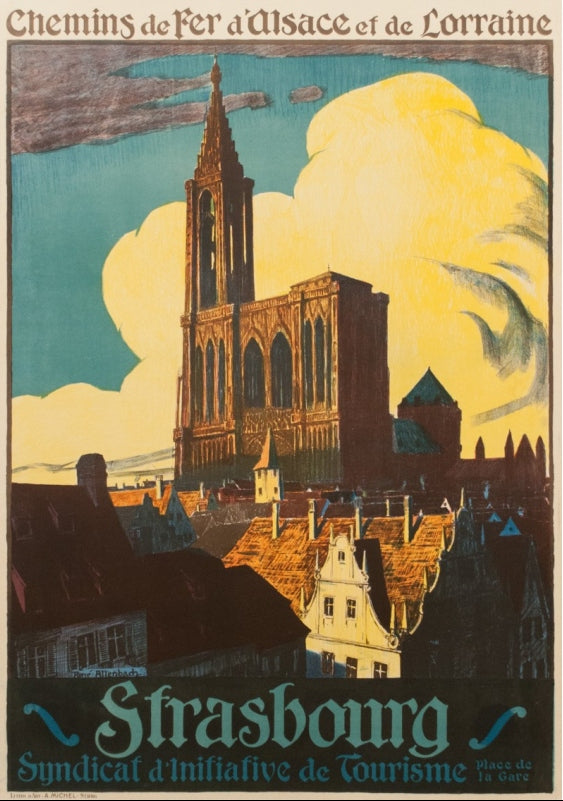
Among the images produced, few carry more weight than René Allenbach's view of Strasbourg. Looking across the rust-red rooftops of the old city, the Gothic spire of Notre-Dame rises above everything else, calm and unmoved. The cathedral had been the city's landmark for centuries and it did not change nationality. The poster leans on exactly that: whatever the politics of the moment, the city and its skyline endure.
It is a persuasive image precisely because it never argues. There is no slogan competing for attention. The city speaks for itself.
Who was Allenbach?
René Allenbach (1889–1958) was not a Parisian poster designer sent to visit the provinces. Born in Nanterre into an Alsatian family, he grew up in Alsace, studied at the École des Arts Décoratifs in Strasbourg from 1905 to 1910, then in Leipzig under the engraver Aloyse Kolb, whose influence stayed with him. Settled in Strasbourg as an illustrator and engraver, he went on to master woodcut, etching, lithography, oil and watercolour, most often turning to Alsatian and Strasbourg landscapes. He was a founding member of the Association des Artistes Indépendants d'Alsace, taught at the École des Arts Décoratifs from 1928 and later became its director.
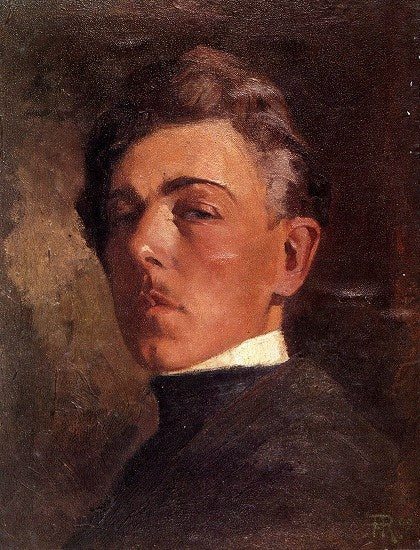
Self-portrait by René Allenbach.
Those local roots matter. He drew Strasbourg the way someone who lived there saw it, and it shows.
More than a railway poster
The cathedral is a recurring subject. Allenbach drew it again for the 8th National and Inter-Allied Congress of Student Associations, held in Strasbourg on 20–25 November 1919, only a year after the city returned to France. This time the spire rises behind a sea of tiled roofs, in a palette of grey-blue, ochre and cream.
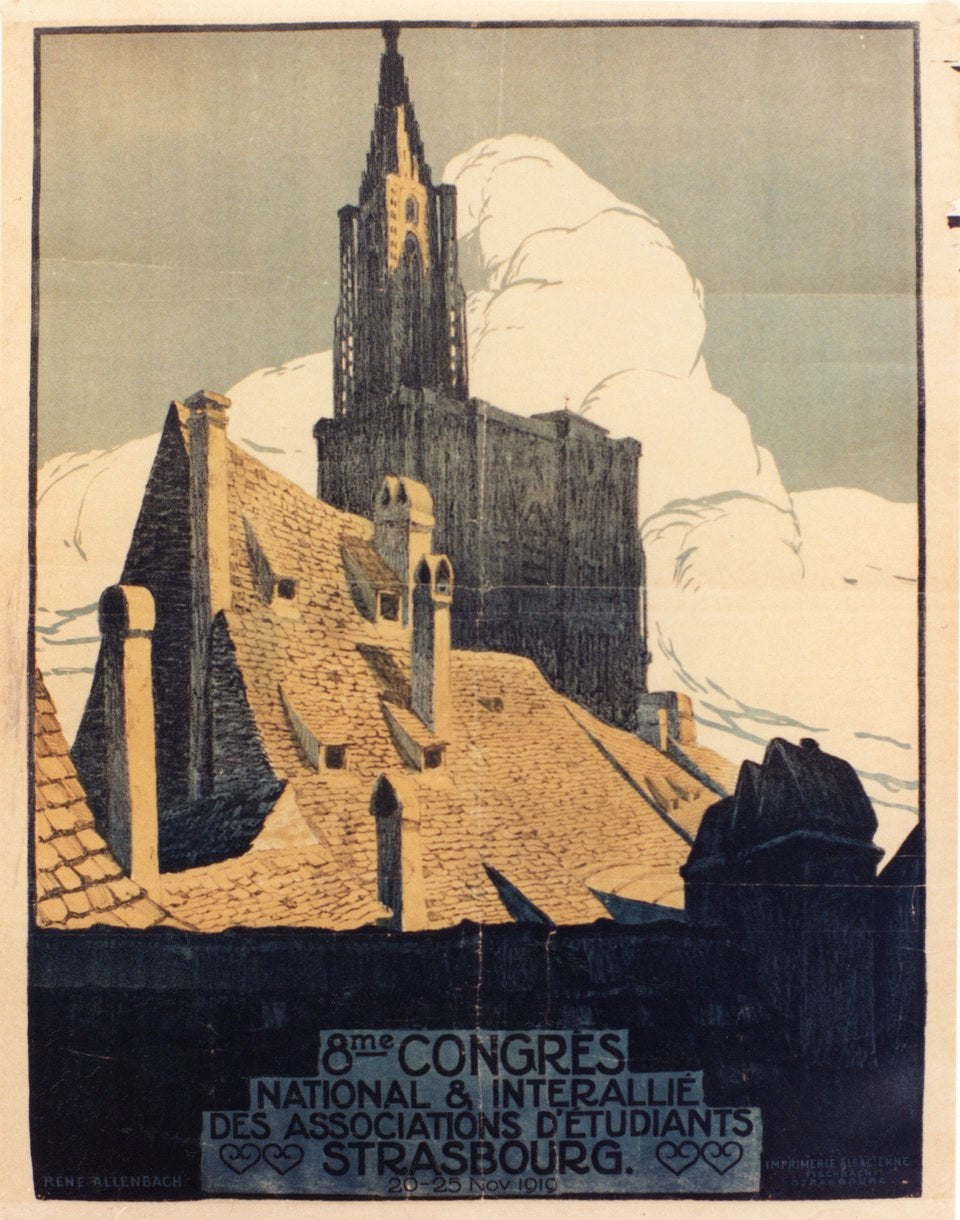
Congress of student associations, Strasbourg, 1919.
Ten years later he was working in a very different, Art Deco register. His 1932 poster for the Strasbourg music festival pairs a violin, a clarinet and a score with the cathedral silhouette, under bold geometric lettering. The programme was a serious one: the Berlin Philharmonic under Furtwängler, the Lamoureux Orchestra and the Strasbourg Municipal Orchestra.
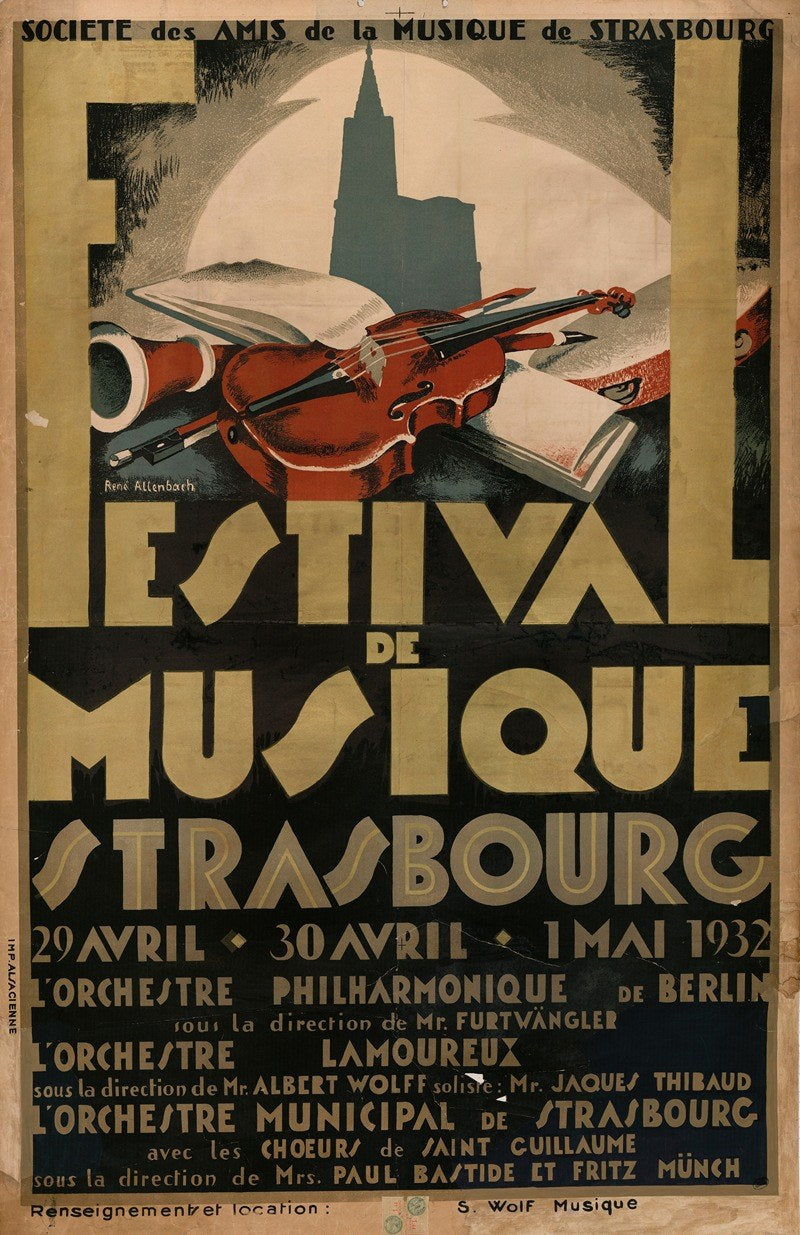
Strasbourg music festival, 29 April – 1 May 1932.
A poster in a museum
This poster is held in the permanent collection of the Musée d'Art Moderne et Contemporain de Strasbourg (inventory number 55.002.0.36). Museum recognition of a commercial poster is a good indicator of both its artistic quality and its importance to the region's cultural heritage.
The piece in the gallery
Our copy is an original from 1924, signed bottom left, and measures 75.5 × 105 cm. It is linen-backed and in condition A-. If you would like to understand what those terms mean, we explain them in How to tell an original vintage poster from a reproduction.
For us in Strasbourg, it is a particular pleasure to offer it. It is a poster about the city we work in, made by an artist who worked here too.